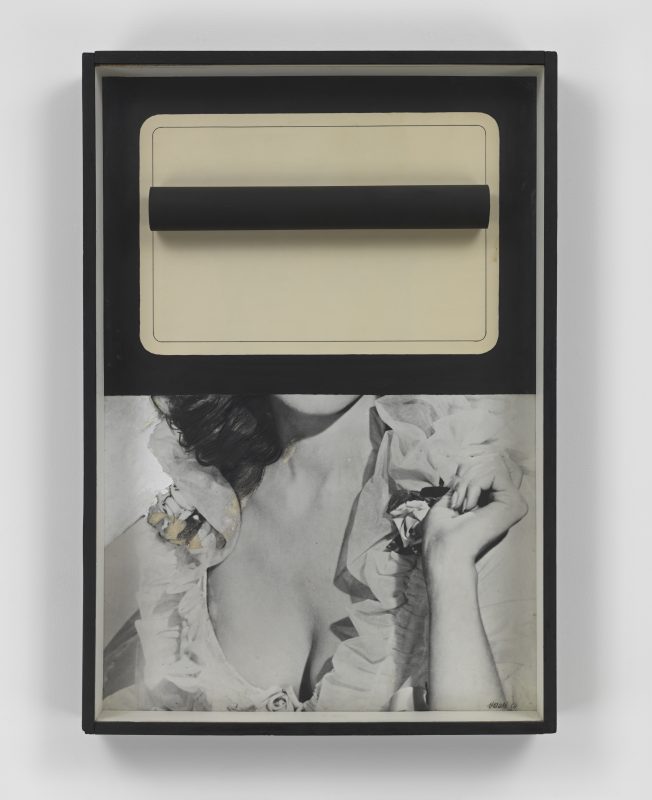
Fabio Mauri, Marilyn, 1964, Collection privée, Milan, Courtesy The Estate of Fabio Mauri and Hauser & Wirth.
For the first time in France since 1981, the MAMAC presents a major project dedicated to the Italian art scene between 1960 and 1975.
“Vita Nuova. New challenges for art in Italy. 1960-1975” aims to uncover the extraordinary vivacity of artistic creation in Italy between 1960 and 1975, whose diversity remains very little known in France – with the exception of the works of Arte Povera artists.
Between the early 1960s and mid 1970s, Italy experienced a particularly fertile and exceptional period, inextricably linked to the richness of cinema and literature of the period.
Paradoxically, since the exhibition held at the Centre Pompidou National Museum of Modern Art (Paris) in 1981 “Identité italienne. L’art en Italie depuis 1959”, curated by Germano Celant (1940-2020), there has been no major overview of this remarkable art scene in France.
Curated by Valérie Da Costa, art historian, specialist in Italian art, this exhibition makes up for this historical gap, offering an unprecedented take on these fifteen years of creation from 1960, which corresponds to the first exhibitions of a new generation of artists (born between the years 1920 and 1940) active in Genoa, Florence, Milan, Rome and Turin – to 1975, a year marked by the tragic death of the writer, poet and director Pier Paolo Pasolini (1922-1975). The year 2022 marks the centenary of his birth.
This generation of artists offered up new ways of understanding and making art: they illustrated a form of vita nuova (“new life”) a title borrowed from Dante’s eponymous book (Vita Nova) which, while serving as an ode to love, asserts a new way of writing, marking Italian art in this period and contributing to its international recognition.
During the 1960s and 1970s, Italy’s transformation (industrialism, consumer society, political instability, etc.) resulted in new modes of representation. It is this historical and political context that forms the background of this exhibition.
This exhibition takes on a resolutely thematic perspective and is organised around three main ideas: A society of images, reconstructing nature and the body’s memory, all considered in a porous and cross-cutting nature, in order to demonstrate the circulation of artists, forms and ideas between visual, ecological and corporeal issues.
The exhibition aims to present a diverse, non-exhaustive artistic landscape, composed of a selection of artists – some of whom have been forgotten in the world of Italian art (particularly with regard to female artists) – whose work is exhibited for the first time in France and has been recently rediscovered in their own country.
Developed as a multidisciplinary exhibition, ” Vita Nuova ” explores the links that have been established simultaneously between visual creation, design and cinema.
The exhibition presents 56 artists, including many women artists, through a selection of 120 works and archival documents from Italian and French, public and private collections.
Artists: Carla Accardi, Vincenzo Agnetti, Franco Angeli, Giovanni Anselmo, Archizoom, Michelangelo Antonioni, Gianfranco Baruchello, Tomaso Binga, Irma Blank, Alighiero Boetti, Marisa Busanel, Pier Paolo Calzolari, Lisetta Carmi, Elisabetta Catalano, Mario Ceroli, Claudio Cintoli, Gino De Dominicis, Luciano Fabro, Federico Fellini, Giosetta Fioroni, Rosa Foschi, Piero Gilardi, Giorgio Griffa, Alberto Grifi, Laura Grisi, Gruppo Strum, Paolo Icaro, Jannis Kounellis, Ketty La Rocca, Maria Lai, Sergio Lombardo, Renato Mambor, Lucia Marcucci, Titina Maselli, Fabio Mauri, Eliseo Mattiacci, Marisa Merz, Mario Merz, Franco Mazzucchelli, Ugo Nespolo, Luigi Ontani, Giulio Paolini, Claudio Parmiggiani, Pino Pascali, Luca Maria Patella, Pier Paolo Pasolini, Giuseppe Penone, Marinella Pirelli, Michelangelo Pistoletto, Carol Rama, Mimmo Rotella, Mario Schifano, Ettore Spalletti, Gerry Schum, Cesare Tacchi, Gilberto Zorio.
The exhibition is also the subject of a collaboration with the Villa Arson through “The Future behind Us”, curated by Marco Scotini, to be discovered from 11 June to 18 September 2022. Dedicated to the Italian art scene of the 1990s and 2000s, the exhibition brings together some twenty artists whose contemporary works resonate with the utopian ideas of their elders.
“Vita Nuova. New challenges for art in Italy. 1960-1975” has been officially labelled as part of the French Presidency of the Council of the European Union’s cultural calendar of events from january to june 2022.


Exhibition Journal
Exhibition catalog
Exhibition curator:
Valérie Da Costa, art historian
Project manager Laura Pippi-Détrey, MAMAC
Main Partners


Other Partners