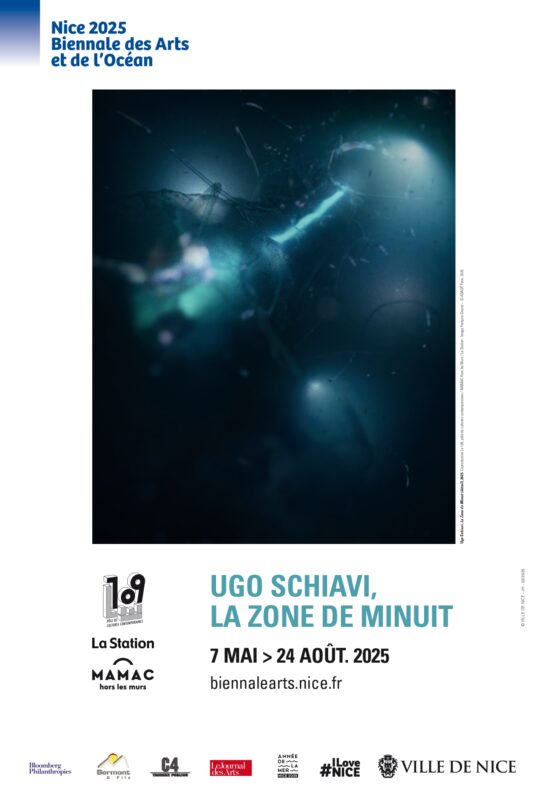
Ugo Schiavi, La Zone de Minuit (détail), 2025
Coproduction Le 109, pôle de cultures contemporaines / MAMAC Hors les Murs / La Station ; Image François Gouret, © ADAGP, Paris, 2025
MAMAC near you
Grande Halle, Le 109: Contemporary Culture Centre
Wednesday to Saturday, 11.00am to 6.00pm, Free admission
89 route de Turin, 06300 Nice / le109@nice.fr / 04 89 98 25 73
As part of the Biennale of Arts and the Ocean, “The Sea Around Us”, artist Ugo Schiavi is coming to the Grande Halle of the former slaughterhouses of Nice with an immersive installation on the world of the abyss, produced specially for the exhibition.
The deep sea is our planet’s last terra incognita. The pressure exerted there, absence of light and absolute immensity of these spaces meant humans had only myths, tales and legends to tell about these ecosystems for centuries, from Pliny the Elder to Jules Verne. Today, during rare expeditions into these strange worlds, scientists can glimpse landscapes through the headlights of their submarines that no human has seen before. They are discovering extraordinary life forms that thrive in an extreme environment that was long thought to be completely sterile. And despite this lack of knowledge, the abyss is the very foundation of life on Earth.
The initial inspiration for the project is based on this paradox: we can go to the Moon and date the presence of water on Mars, but we know almost nothing about what makes up the vast majority of the Earth’s surface. Worse still, barely explored, the abyss is already threatened by the risk of human exploitation*.
The project, titled The Midnight Zone**, offers a vertical descent toward the unfathomable. It will take the form of an immersive, composite installation. Comprising a series of sculptures and computer-generated film, the work plunges the audience into a fantasy exploration of the abyss, where humans and non-humans are inextricably linked in their sprawling practices. Here, marine myths, digital technologies and ecological issues intertwine.
The sculptures
Through a series of hybrid, translucent, luminous sculptures (with glass as the main material*), the project intertwines organic and synthetic, fiction and reality. Suspended from metal structures that once held animal carcasses, these enigmatic forms conjure up abyssal, almost alien creatures. Like fragments of digital ecosystems, they reveal through transparency a complex network of cables and technological devices. A current flows between the works, like a (super)natural force that connects them together.
Light, or more precisely bioluminescence, is the way to communicate in the abyss. While we imagine a world of darkness, it actually shines with particles, trails and other luminescent explosions. And so, by analogy, the sculptures produce their own light, forming the only light sources in an installation plunged into darkness.
The film
In a continuous back-and-forth between real and virtual, the creature-sculptures, first modelled in 3D, then made real, return to their digital state to become the protagonists in a computer-generated film. They unfold in a paradoxical reality where nature and technology coexist in a strange symbiosis.
The sound, a key element of this experience, was designed in collaboration with a bio-acoustician whose research focuses primarily on recording and studying the sounds of the deep. A distant echo and deep rumble, it envelops the audience, allowing them to feel the presence of the deep sea like a freedive into an unknown world.
A captivating installation
Thinking of all the cables that connect us through our screens and run along the seabed like artificial veins, there is no doubt that today we are connected more than ever by multiple flows, within a globalised scenario that highlights our responsibility towards the planet.
This installation questions humanity’s ephemeral relationship with the vulnerability of a changing world. It summons ancestral mythologies of the deep and science fiction stories, while alluding to underwater archaeology and the ecological threat weighing on these fragile ecosystems. In this way, the works are revealed as enigmas served up in a dark and contemplative poetry, which pose the question of the passage of time and the world, from the secret of its genesis to the mysteries of its end.
“It is with the sea that the world began, so to speak, And who knows if it will end with it! Therein lies supreme tranquillity. The sea does not belong to despots.” Jules Verne, Twenty Thousand Leagues Under the Sea, 1869-1870
Ugo Schiavi
* Mining industries want to exploit the abyssal plains to extract metals such as nickel, copper and manganese. This extraction would have irreversible consequences for entire ecosystems which are still intact.
**Another name for the bathypelagic zone. This is a layer of the water column between 1000 and 4000 m down where sunlight cannot penetrate.